
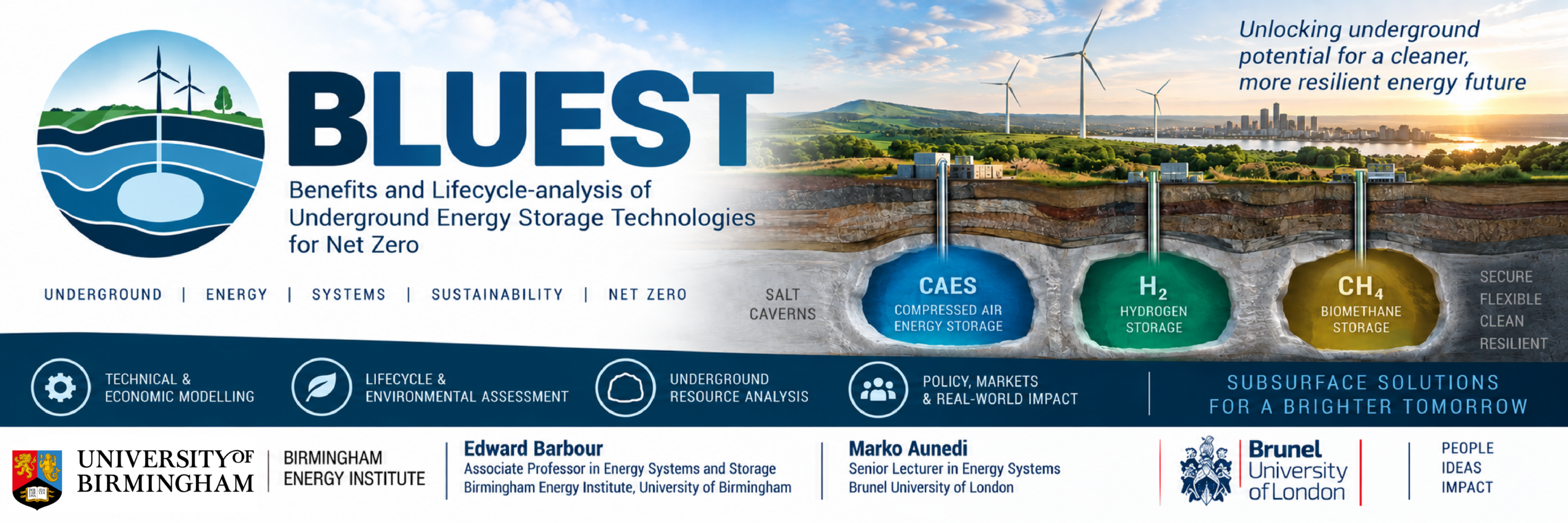
BLUEST seeks to assess the system benefits, economic performance and lifecycle impacts of underground long-duration energy storage (UG-LDES) technologies.
First, we will develop technical and economic models of UG-LDES technologies. These will capture their key physical characteristics, including the relationships between power, energy capacity, charge time and discharge duration, alongside realistic cost functions that describe how capital and operating costs scale with system size. In parallel, the project team will deploy and enhance WeSIM-OS, an open-source whole-system optimisation model that is uniquely suited to capture the value of diverse flexibility options in low carbon energy systems. The resulting UG-LDES models will be suitable for integration within WeSIM-OS, allowing for parametric exploration of a range of technology portfolios and energy storage durations.
Second, we will undertake a detailed investigation of energy storage in salt caverns, examining their technical and economic suitability for competing applications including compressed-air energy storage (CAES), hydrogen storage and biomethane storage. This will further feed into WeSIM-OS to help identify where different storage technologies offer the greatest system value and how the UK’s underground storage resource might best be utilised.
Third, UK climate projections (UKCPs) will be utilised to capture wind/solar variability and generate future-looking climate extremes to stress-test the system models in WeSIM-OS against extreme weather. This will help to understand the value of LDES for resilience against seasonal scarcity and ‘dunkelflaute’ events.
Fourth, we will undertake a lifecycle and environmental assessment of UG-LDES technologies. A consistent cradle-to-grave framework will be developed covering construction and manufacture, operation, maintenance and end of life. The assessment will quantify embodied energy and greenhouse gas emissions while also considering wider environmental impacts (including land use, water consumption, material requirements).
Finally, throughout the project we will investigate the non-technical barriers to UG-LDES deployment, including regulatory, planning, market and investment barriers. Working with external partners including NESO, DESNZ and the Energy Systems Catapult, we will identify opportunities for the project’s evidence and modelling to inform UK policy and future support mechanisms for long-duration energy storage.