Article
CSIR to Host Africa’s First RD20 Conference on Clean Energy Innovation
09 September 2026

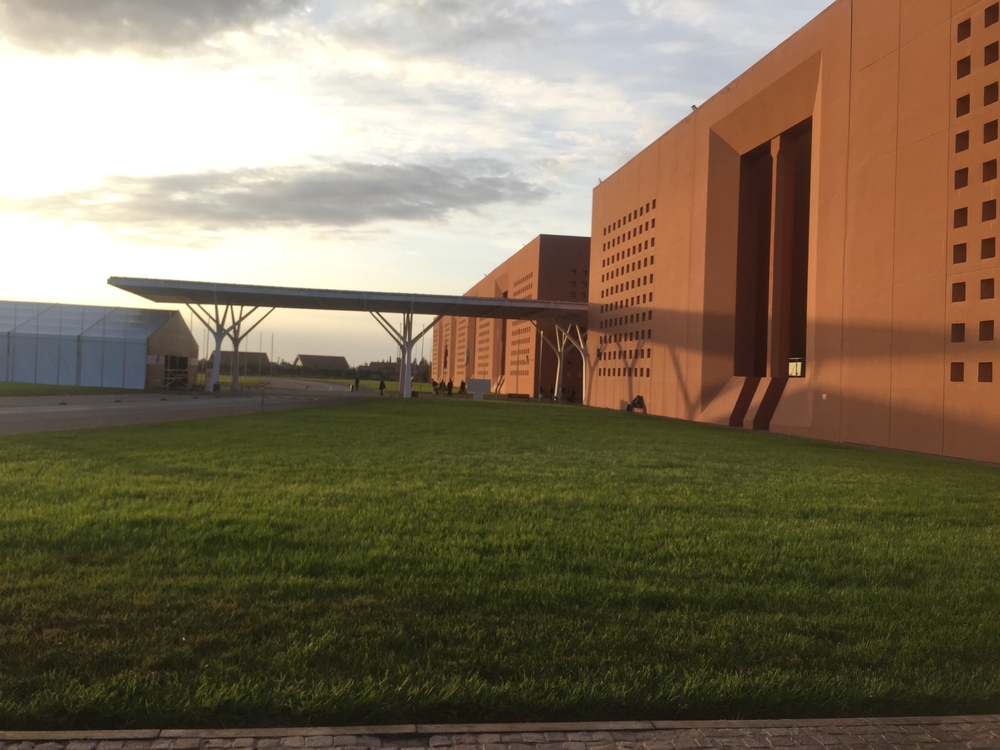
The 4th RD20 Summer School opened with a sense of possibility that would only deepen as the week progressed. Beyond broadening my technical perspective, the experience enriched me culturally in ways I had not anticipated.

Samuel Widijatmoko at the RD20 Summer School
My own research is largely national in scope and focuses on the recycling of critical minerals from waste electronics in the UK. Arriving here was a reminder of how easily that narrow lens causes me to overlook the scale of challenges that remain unsolved beyond those borders. Recycling depends on the accumulation of sufficient material stocks to be economically viable at scale. It is a framework built on the infrastructure and consumption patterns of industrialised economies, and it does not translate neatly to regions still in the process of building that base.
The deployment of net-zero technologies such as solar and wind is far from universal. Geological and infrastructural constraints mean that a solution viable in one region may be entirely impractical in another. Nowhere is this paradox more acute than in Africa, where the contrast is stark. Morocco, the very country hosting this summer school, has achieved near 100% electrification, yet some nations on the same continent still fall below 40%. Furthermore, the continent faces expectations to decarbonise, despite contributing only around 3% of global CO₂ emissions. It is a striking conundrum in which large ambitions are placed on a region with a significant development deficit and a minimal historical share of the problem.
As the day progressed, through conversations with new acquaintances and an expert panel discussion, a more optimistic framing began to emerge. Many participants believe Africa’s story can be written differently. Leapfrogging fossil fuel dependency is not only possible but plausible, precisely because net-zero technologies are maturing at a remarkable pace. Solar panel costs, for instance, have fallen from around $0.30/Wp for polycrystalline modules to as low as $0.10/Wp for monocrystalline modules. It is important to note that monocrystalline technology is superior to polycrystalline technology. Better technology with a 70% cost reduction in just five years is phenomenal. For a continent building much of its energy infrastructure from scratch, that trajectory is less of a challenge than an opportunity.
The second day opened with a talk by Anthony Burrell (NLR, USA), entitled “Understanding and Advances in Battery Energy Storage.” Having completed my PhD in Li-ion battery recycling, I found this an enjoyable return to familiar territory.
Anthony opened with a timely caution against science-by-press-release, drawing a clear distinction between science and technology. His central reminder was a simple but important one: a Li-ion battery is governed by physics, specifically by the thermodynamic constraints of standard electrode potentials. To illustrate the ceiling of what science permits, he noted, with some dry humour, that a LiF-based battery would theoretically yield an overall cell voltage of 5.92 V. Scientifically, there is nothing precluding it. Technologically, it remains entirely unfeasible.
The most practically significant point of the talk was that viable Li-ion battery chemistries are effectively constrained to the first row of transition metals. They are more abundant on Earth and strike the right balance among cost, energy density, and power output. It is a constraint that researchers in recycling often overlook, yet it carries an important implication. If first-row transition metals represent the realistic sweet spot for battery chemistry, then anyone working in the field, such as hydrometallurgical recycling, can take some comfort in knowing that the elemental scope of their work, first-row transition metals plus lithium, is unlikely to shift dramatically. In a field where complexity can spiral quickly, that is a meaningful boundary to have.
In the afternoon, attendees were divided into groups to work through three case studies over the remainder of the week, with solutions to be presented by Friday. The first case study centred on the selection between Li-ion and Na-ion batteries for buffer storage in green ammonia production powered by intermittent renewable energy. After a productive two-hour discussion, our group came down in favour of Na-ion, on the grounds of comparable cost and superior thermal safety. Thermal safety is a particularly relevant consideration given that ambient temperatures in Morocco can reach 45°C during peak summer. After the group discussion, we rounded off the evening with a game of bowling!
The third day opened with a talk by Julie Mougin (CEA, France), entitled “Green Hydrogen Production: A Clean Molecule for a Net Zero World.” Julie began by contextualising the scale of industrial hydrogen demand, reported at 100 Mt/yr in 2024. She outlined five electrolyser technologies, classified by electrolyte type and operating temperature: the proton-conducting ceramic electrolyser (PCCEL), solid oxide electrolyser (SOEL), proton-exchange membrane water electrolyser (PEMEL), alkaline water electrolyser (AEL), and anion-exchange membrane water electrolyser (AEMEL). Of these, PCCEL and SOEL use steam as the feed, while PEMEL and AEL use liquid water. Crucially, only PEMEL and AEL are currently deployed at an industrial scale. Julie concluded by emphasising the growing need for hydrogen transport and storage infrastructure as the technology matures.
This was complemented by a talk from Yuichi Manaka (AIST, Japan) on green ammonia. Yuichi made a compelling case for ammonia as a carbon-free hydrogen carrier. Its key advantage is compatibility with existing industrial infrastructure, making storage and transport considerably more tractable than for hydrogen itself.
Bill Tumas (NLR, USA) delivered a talk entitled “Solar Fuels: From Photosynthesis to Artificial Photosynthesis.” He opened with a 1938 film clip featuring Jimmy Stewart on solar energy, a charming way to frame the long history of human fascination with sunlight-to-X conversion. It also served as a reminder that fossil fuels are, at their core, nature’s own method of storing solar energy. Bill then turned to the economics of the energy transition, using petroleum as a reference point. The figures were striking, fuels account for 76% of US oil products and are valued at $935 billion, while chemicals represent just 16% yet generate $812 billion in value. Roughly half the revenue derives from one-sixth of the volume. It is a powerful illustration of the product economics that could make biomass-derived chemicals a compelling proposition, not just environmentally, but commercially.
The morning session closed with a talk by Tata Sutardi (BRIN, Indonesia), entitled “Carbon Capture, Utilisation and Storage: From Emission to Solutions.” Tata outlined why carbon management is indispensable to net-zero pathways and walked through the current state of CCUS development in Indonesia, including the BRIN CCUS roadmap. The central takeaway was clear: deep emission reductions alone will not be sufficient, and no single carbon capture technology fits all contexts. The right solution must be matched carefully to source characteristics, cost constraints, and specific decarbonisation objectives.
The afternoon took a welcome turn as the group set off for Agafay and Marrakech. En route, the organisers arranged a visit to a local argan oil producer, a small but memorable glimpse into one of Morocco’s most distinctive industries. In the Agafay desert, I took in the sweeping landscape and managed to ride a camel, which was not something I had anticipated ticking off at an energy research summer school. I also had a thoroughly enjoyable conversation with Tata Sutardi, ranging from the themes of his talk to the broader importance of critical minerals recycling for the net-zero transition, a topic close to my own research. We rounded off the evening with a selfie before heading on to Marrakech for dinner at the Jemaa el-Fna.

Samuel Widijatmoko & Tata Sutardi at the conference
The fourth day opened with a talk from Eliza Hotchkiss (NLR, USA), entitled “The Web of Supply Chains and Critical Minerals in the Electro-Digital Age.” Eliza emphasised the systemic importance of critical minerals, noting that digital applications and power grids are wholly dependent on them, that access is far from equally distributed across nations, and that the entire supply chain is exposed to risk. This was followed by a talk from Romain Gautier (CNRS, France) entitled “Faster, Smarter and Cleaner: AI-Driven Innovation in Materials Science.” Romain began by grounding the audience in what machine learning is and why it is particularly well-suited to materials science. The key takeaways were that AI can accelerate data analysis, support decision-making, and aid navigation through multi-dimensional parameter spaces, while also providing mechanistic insight into underlying physics. The caveat, however, is that large and reliable datasets remain scarce, which continues to limit the broader applicability of these methods.
The second half of the morning session featured lectures on hydrogen and ammonia safety best practices by Ghulam Abbas (UM6P, Morocco) and a sustainability overview by Stephanie Riche (CEA, France). These sessions were designed to equip participants with the background knowledge needed to tackle the upcoming case study.
In the afternoon, groups reconvened to work through the second case study: evaluating the climate cost of ammonia production by comparing the conventional and green Haber-Bosch processes. The discussion centred on the trade-offs between economic performance and emissions reduction, and it highlighted why blue ammonia continues to be regarded as a transitional solution rather than a long-term one. After the group discussion, we rounded off the evening in fine style with a gala dinner in Marrakech!
The fifth and final day began with a lecture by Debajeet Bora (UM6P, Morocco) on the electrification of critical mineral mining. The lecture emphasised the importance of electrifying comminution equipment, such as ball mills, and transfer vehicles. Electrification makes mining operations safer, particularly in cave mining, where emissions from internal combustion engines can be significantly reduced, improving working conditions for miners. It also opens the potential to integrate renewable energy into mining operations, reducing their broader environmental footprint.
Following the lecture, we returned to our groups to discuss the third and final case study, focusing on strategies to reduce the carbon footprint of materials extraction. In parallel, we prepared our presentation for the afternoon session. Our group presented on decarbonising fertiliser production through two interconnected pathways: the transition to green ammonia production and the circularity of phosphogypsum. We outlined the opportunities and practical pathways for each, making the case that these two levers, pursued together, represent a meaningful step towards a lower-carbon fertiliser industry.
Reflecting on the week, Africa left the strongest impression. It is a continent that is often discussed in terms of its deficits, yet the conversations here consistently pointed towards a different narrative. The combination of abundant solar resources, growing political will, and rapidly maturing net-zero technologies creates a genuine window of opportunity. Unlike industrialised nations that must decarbonise existing infrastructure, Africa has the rare advantage of building much of its energy and industrial base from scratch. If that opportunity is seized, the continent could leapfrog not just fossil fuels, but the inefficiencies that come with them. That is not a certainty, but after this week, it feels like a real possibility.
About the author:
Dr Samuel Widijatmoko, is based at the University of Birmingham, where he is a Research Fellow in Metal Recovery from Secondary Sources for Energy Storage