
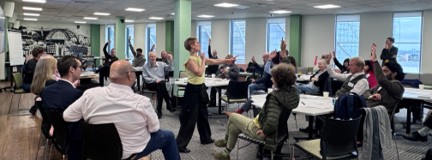
What would make public electric vehicle charging work for everyone? More chargepoints are just part of the answer. Recent discussions at our Legislative Theatre workshop highlighted a wider set of concerns: inaccessible infrastructure, complicated payments, unequal charging costs, fragmented planning and difficulty finding trusted information. Our Legislative Theatre workshop used participatory performance to explore everyday barriers to EV charging, inviting participants to test possible solutions and collectively develop proposals for change.
Held at Newcastle University Business School on 12 October 2026, the workshop was delivered in collaboration with Theatre of the Oppressed North East led by Rosa Stourac McCreery. Using Legislative Theatre, participants explored barriers to fair EV charging and developed proposals for change.
Theatre-based performance provided a shared starting point for examining how these barriers affect everyday journeys. Participants were able explore interventions, question their implications and consider what wider policy changes would be needed to make them work. The discussion moved from individual difficulties to collective questions about responsibility, resources and accountability.
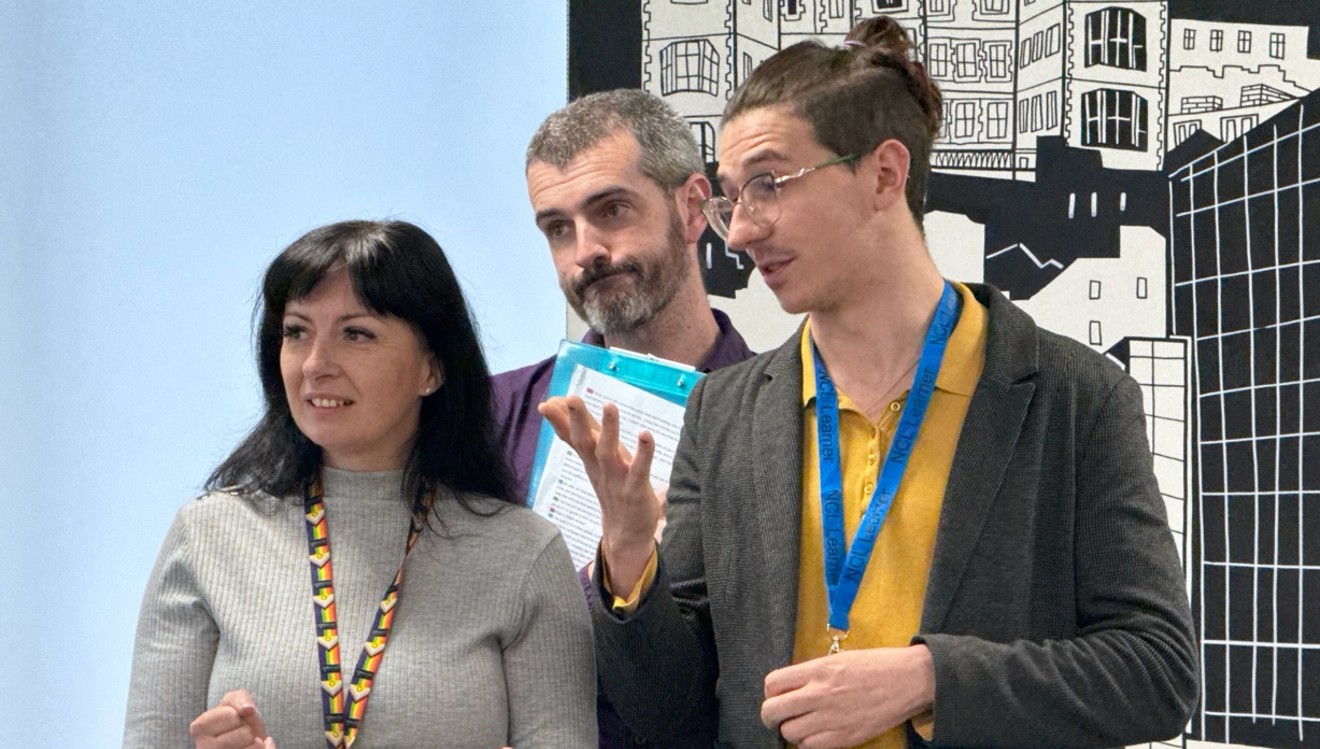
Exploring everyday EV charging barriers through theatre-based performance.
Making PAS 1899, the British standard for accessible public EV charging, mandatory emerged as a leading priority in the workshop Participants called for compliance with the accessibility standard to be required in contracts for publicly funded chargepoints and made a condition of public funding, supported by clear regulatory oversight and effective enforcement. Their recommendations also addressed the experience of using charging infrastructure: consistent and simple payment processes, contactless options, well-lit locations and assistance for disabled motorists.
These proposals connected infrastructure design with the wider charging journey. A charger’s presence does not, by itself, mean that someone can reach it, operate it, pay for charging or obtain help when needed. Participants wanted clearer division/allocation of responsibilities for ensuring that accessible provision translates into usable services.
Affordability was another central concern. Participants considered both the cost of obtaining an EV and the ongoing cost of charging it as important.
Proposals included interest-free loans for second-hand EVs, targeted grants for households on low incomes, and scrappage schemes. Car clubs, shared vehicles and community charging arrangements were also discussed as ways to broaden access.
Participants additionally proposed arrangements that would allow people using public charging to benefit from prices closer to those available through home electricity tariffs.
These ideas require further assessment, including their feasibility and distributional effects. They nevertheless raise a clear policy question: how can the transition accommodate people whose income, housing or parking arrangements make electric mobility harder to access?
Participants called for greater consistency across charging payment systems. Suggestions included a unified payment platform and a physical chargecard that could be used across different charging networks, making payment easier without requiring a smartphone or multiple apps. Digital inclusion was an explicit concern. Participants stressed that charging should remain accessible to people who do not have a smartphone.
The discussion highlighted how payment arrangements can become barriers in their own right. Making charging easier to navigate means considering the practical steps people must complete, alongside the availability and price of electricity.
Participants also wanted a clear, trusted source of unbiased information to help people make informed decisions about switching to an EV.
The discussion also recognised that information needs to reach beyond people already engaged in electric mobility. Suggestions included community conversations, independently convened public meetings and advice delivered through familiar organisations.
Trust and opportunities to ask questions were central to these proposals. Participants wanted communication that responds to people’s circumstances and concerns, including questions about costs, practical suitability and who benefits from the transition.
Importantly, these conversations also considered travel needs and choices more broadly, including access to employment, healthcare, education and social activities.
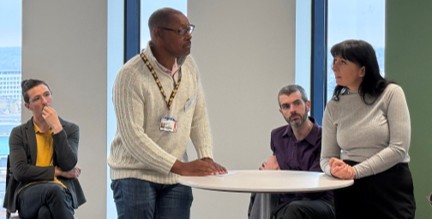
An audience-performer dialogue on EV concerns
Participants proposed a national platform bringing together chargepoint demand and utilisation data to inform infrastructure funding and placement.
They also called for this information to be combined with geographical analysis, insights into how and why people choose where and when to charge, and feedback from existing and potential users.
A key implication is that recorded charging activity provides only part of the evidence needed for fair planning. Understanding unmet need also requires listening to people who face barriers to using the infrastructure or adopting an EV.
The workshop connected these proposals to wider transport choices, including public transport, walking, wheeling, cycling and shared mobility. Participants questioned how available resources could support fairer access to travel across these options.
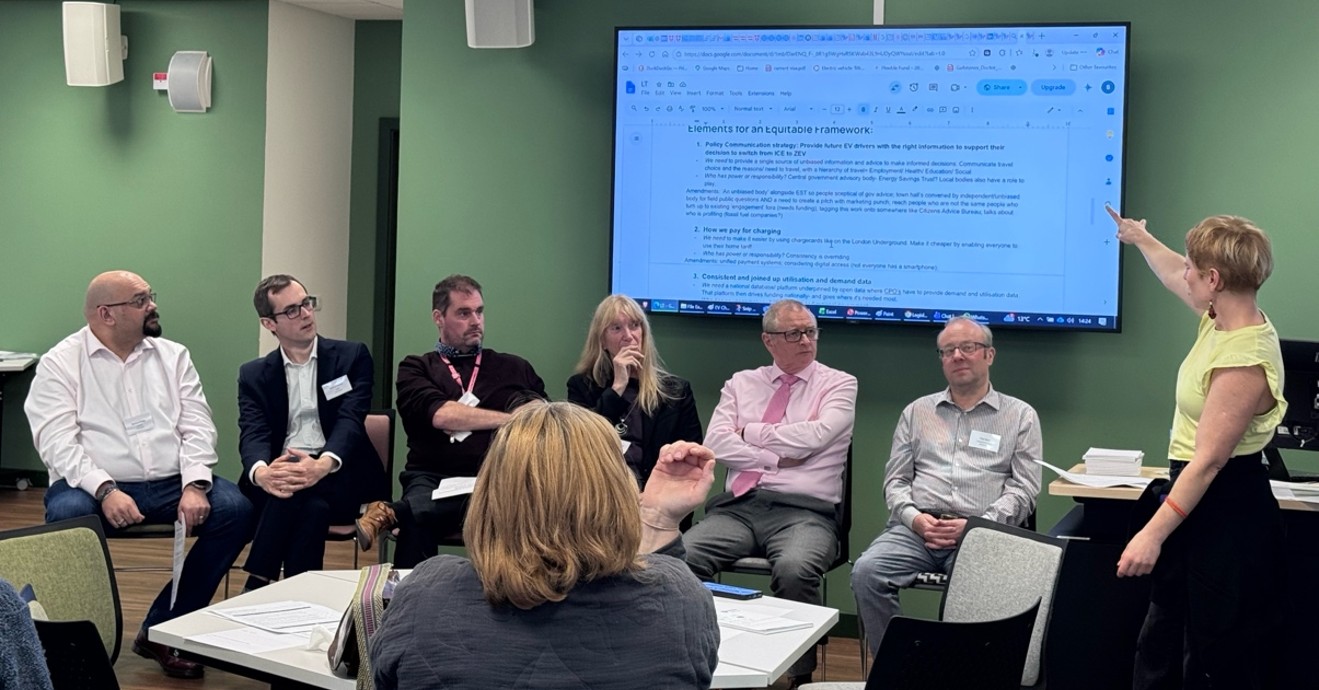
Discussing proposals for fairer and more accessible EV charging.
The workshop identified possible routes for taking the recommendations forward, including local authority strategy development, collaboration on data, accessibility campaigning and parliamentary discussion.
These proposals reflect the priorities developed by workshop participants and represent a starting point for broader conversations about fair and accessible EV charging. Further engagement with diverse communities and evaluation will be needed to refine the proposals and assess their effectiveness. The next step is to refine the recommendations with the relevant organisations, examine their feasibility, and maintain a clear connection between participants’ contributions and subsequent decision-making.
For INTERSECT-CHARGE, the value of Legislative Theatre lies in creating space to explore how everyday experiences connect with policy choices using a creative approach. Working with Theatre of the Oppressed North East and Rosa Stourac McCreery helped bring questions about charging infrastructure into a participatory discussion about who can use it, who faces barriers and who has the power to make changes.
A fair transition requires sustained attention to these questions as charging networks develop.