
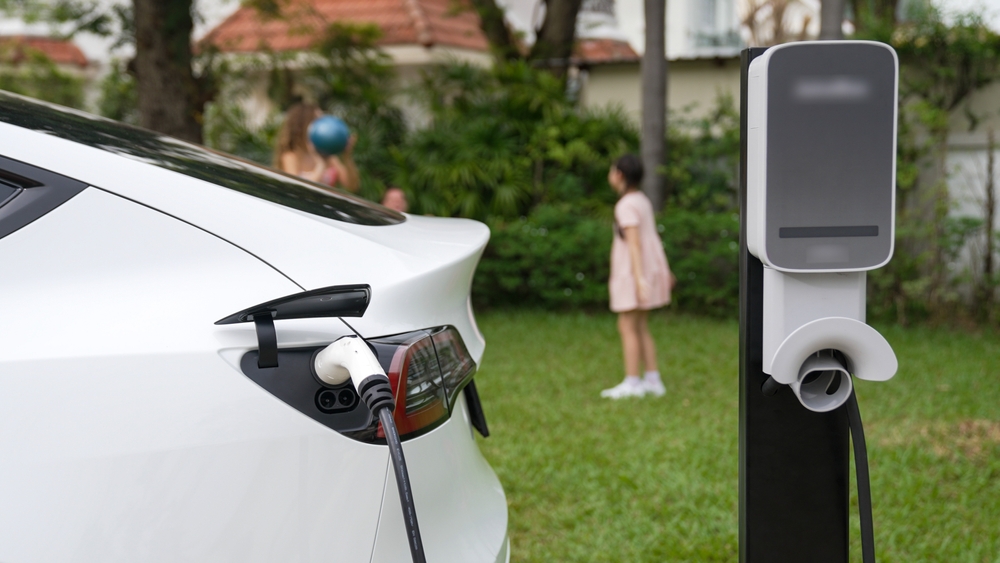
An electric vehicle charger may appear on a map, it may count towards a local target, but it can still fail the people who are expected to use it. It may be too expensive to rely on regularly. It may be on a poorly lit street, behind a kerb that is difficult to navigate, or too far from home for someone without private parking. It may not work for a driver with a disability, a carer managing tight routines, or a renter who has no realistic alternative to public charging.
As the UK moves towards electric mobility, it is tempting to measure progress by the number of chargepoints installed. More infrastructure matters, but numbers alone do not tell us whether people can actually charge in ways that are affordable, reliable, safe and compatible with everyday life. A fair transition needs to ask a harder question: who can genuinely benefit from EV charging, and who gets to shape the decisions behind it?
Electric vehicles are central to reducing transport emissions, but access to charging is not equally shared. People with driveways can often charge at home, usually more conveniently and at lower cost. Others depend on public infrastructure, including renters, residents of flats, lower-income households, disabled users, rural communities, and people whose housing or work patterns make home charging difficult or impossible.
For these groups, the challenge is rarely just whether a charger exists nearby. It is whether charging fits into daily responsibilities, whether tariffs are manageable, whether sites feel safe at different times of day, whether payment systems are usable, and whether equipment can be accessed independently.
A charging strategy that focuses only on coverage risks overlooking these realities. It may deliver more infrastructure while still reproducing existing inequalities.
Our preliminary findings go beyond highlighting technical challenges. They include policy recommendations, driver experience, adoption behaviour, infrastructure planning and accessibility, geographical charging contexts, local authority governance, funding arrangements, and market dynamics.
Interviewees described anxiety about reliability, the effort needed to plan journeys, waiting times at charging sites, ease of payment, safety and anti-social behaviour, public and private coordination, uneven local capacity, and the difficulty of designing infrastructure for people without driveways or predictable routines.
These are early findings, but they already suggest that fair charging must be treated as a social, spatial and governance challenge as well as a technical rollout challenge.
Infrastructure decisions are often framed as technical questions: where demand is highest, where the grid has capacity, where land is available, or where investment is most viable. These questions matter. But they are not sufficient and ignore diverse user needs.
Planning also involves choices about whose needs are seen as urgent, whose knowledge is treated as credible, and whose experiences are absent from the room. A planner may identify an efficient site using traffic or grid data. A local resident may know that the site feels unsafe after dark. A disabled driver may recognise that the layout makes the charger impossible to use independently. A renter may explain how public charging costs alter household budgets.
These are not secondary concerns. They are vital forms of infrastructure knowledge.
This is the premise of INTERSECT-CHARGE: Designing Fair Futures for Electric Vehicle Charging in the UK. The project examines how technology, policy, planning, funding and lived experience interact to create unequal access to charging. It asks how social, spatial and institutional factors combine, and what a genuinely equitable national agenda for charging could look like.
People do not experience infrastructure through a single identity or circumstance. A low-income rural resident may face long distances, unreliable public charging and limited transport alternatives. A disabled renter may face both inaccessible charger design and little influence over parking arrangements. A carer may find that charging systems designed around long waiting times simply do not fit daily responsibilities.
Our project takes an approach to capture the challenges of diverse users. It helps reveal how barriers overlap, rather than treating users as one uniform group. It recognises that people who live with these barriers have insights that can improve infrastructure for everyone.