Briefing paper
The Cost of Electricity in the UK: Drivers, Challenges and Opportunities for Reform
28 July 2026

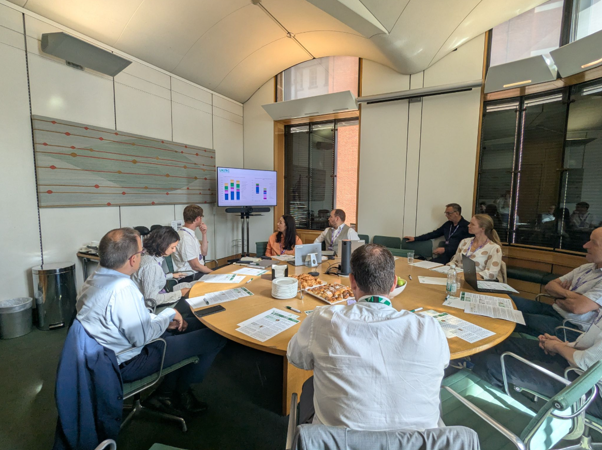
On the 7th of July 2026, as part of Net Zero Week in Parliament, researchers from Strathclyde University’s Centre for Energy Policy (CEP), the UK Energy Research Centre (UKERC), the Energy Demand Research Centre (EDRC) and National Energy Action (NEA) participated in a roundtable discussion with MPs, presenting research centred around the topic of ‘Affordable energy bills in a volatile world’.
Below are the key threads of our roundtable discussion on energy bills, affordability and the energy transition, and my reflections on my first experience of presenting at a parliamentary event as an early-career researcher.
The roundtable discussion covered a broad spectrum of energy affordability-related topics, including the relationship between energy affordability and engagement with net zero, the role of flexibility and demand-side response, the challenge of growing energy debt, what ‘vulnerability’ means in the context of energy bills, and what effective policy intervention should look like.
Drawing on our UKERC research, I gave a whistlestop tour of how electricity bills have evolved in recent years, and where costs are set to grow – the main reflection being that we’re moving into a context where non-commodity costs on bills matter more. Specifically, network costs are becoming a more significant affordability challenge. For example, transmission network (TNUoS) charges over the April-Sep 2026 period have increased by £31 compared to last year, and because these costs are largely recovered through the standing charge, they risk being disproportionately shouldered by low-income, low-energy-use households.
Gesche Huebner from the EDRC highlighted that ‘vulnerability’ in the context of energy affordability can be interpreted in a variety of ways. Narrow definitions risk leaving behind households who need support but do not meet prescribed criteria. There are also emergent forms of fuel poverty which often don’t feature within discussions about support. The recent heatwave, for example, has begun to expose increasing levels of summer energy poverty for households who cannot afford air-conditioning.
Jacopo Torriti, also from the EDRC, spoke to the relationship between affordable bills and consumer engagement with flexibility and demand-side response (DSR). While DSR is anticipated to play a central role in meeting Clean Power 2030, government have not made clear where – or from who – that DSR is expected to come from. This ambiguity could have significant distributional impacts if DSR targets end up being met because three million homes have the means to access all the requisite assets, rather than all homes being able to participate in DSR. It’s therefore important not to overstate flexibility as a universal win-win under current conditions.
Speaking to a similar point, James Mabey from National Energy Action (NEA) highlighted that for households in energy debt, there are less opportunities to switch tariffs, to move away from gas, to access the full value of smart or flexible technologies, or engage with retrofit. Getting people out of debt is therefore often the first step towards engagement with the net zero transition.
Reflecting discussion about how ‘vulnerability’ is not refined to a singular type of household or consumer, there was broad agreement among participants that when it comes to developing interventions to make bills more affordable, a combination of approaches is needed.
Antonios Katris from Strathclyde CEP noted that there are always implicit trade-offs, and that a portfolio approach is best to ensure that different types of vulnerable households receive the support they deserve. For example, social tariffs delivered through unit discounts are more responsive to household energy needs but risk entrenching households with long-term reliance in fuel poverty, and Rising Block Tariffs (RBTs), which initially reduce bills for many households but can disproportionately affect fuel-poor households and are unlikely to remain cost-neutral over time.
James Mabey, NEA, explained that long-term interventions, through retrofit and energy efficiency measures, were necessary, but needed to go hand-in-hand with direct bill support now – whether through an enhanced Warm Home Discount rebate, social tariff or other targeted mechanisms. Over time, as more homes became more efficient, the need for direct bill support would lessen.
This part of discussion was foregrounded by a question from Mike Reader MP, who asked each researcher for their priority recommendation to government. These were:
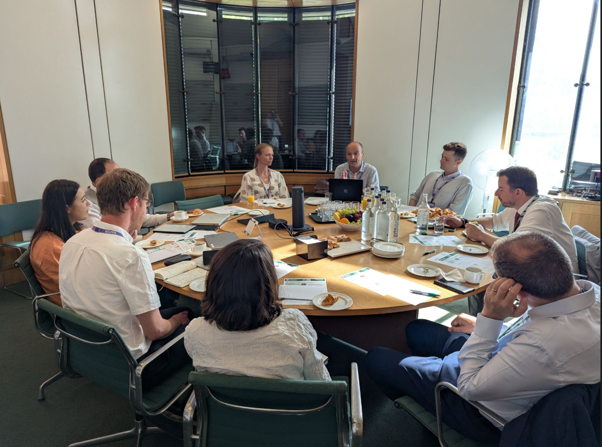
As someone in the early stages of a research career, the experience of presenting at a parliamentary event was a first for me. While policy is a substantive focus of the work we do in the UKERC mission on bills, it felt different being able to speak directly with MPs about our research – and to have space to explore how this could inform decisions around how costs on bills are set and recovered. When you publish a piece of work, you do so without knowing whether it will make its way into the hands of the people you’d like to read it – here, they were right in front of me, and the potential for impact felt more pronounced. I found being privy to responses and reflections on our work in real-time was somewhat intimidating, but ultimately very rewarding for this reason.
Given the importance and complexity of energy affordability as a topic, I felt a strong sense of responsibility to clearly and carefully communicate relevant threads of our research to the MPs. This is a tricky, but important balance when it comes to discussing electricity bills, which, even in their simplest form, still present as a complex and quick-changing web of costs (and accompanying acronyms). It was a good exercise in learning to really tailor research and boil it down to its most salient parts without losing nuance.
I came away with a feeling of having both impacted and been impacted by the discussion. In the days following, I found myself thinking about how I could better integrate aspects of what I’d learned – particularly about how energy affordability and debt influence engagement with flexibility and electrification – into the research we do at UKERC. There was also a renewed awareness of the need to consider potential distributional impacts for all different types of vulnerable households for any policies or reforms we explore.
As a final takeaway, I particularly enjoyed the exposure to the different, but not incompatible, ways of broaching complicated topics. Being in a space which brought together academic and political worlds was reflected in the ways discussion was structured – it encouraged the academic impulse to ask conceptual questions (‘What do we actually mean by vulnerability?’) and be wary of anything presenting as a straightforward answer (‘There are no silver bullets when it comes to solving energy affordability’). But also, thanks to the MPs’ more practical lines of questioning, encouraged pragmatic thinking about how our research could best direct policy. I left my first parliamentary roundtable feeling a stronger charge to continue to ask questions, even in the face of complicated or unknowable answers, but also to think seriously about how the work I do as a researcher can best be used to serve a real-world purpose.