

Decarbonising global economies through low carbon energy transitions requires the deployment of renewable energy technologies (solar farms, wind turbines) and their connecting infrastructures (such as Overhead High Voltage Power Lines, or OHVPL). The deployment of such technologies and infrastructures can incite diverse responses, from ardent support through indifference to strong opposition from a range of different stakeholders.
For decades, social acceptance research has developed novel theoretical frameworks to explain why these responses occur, including the role of engagement processes, project-specific factors and place-specific contexts, amongst others. OHVPL are complex, since they bisect multiple – but distinct – places concurrently, creating extensive impacts for local communities.
However, existing research has over-focused on negative community responses to OHVPL, indirectly positioning local communities as “obstacles” to technological innovation and societal progress. Comparatively less emphasis has been placed on the motivations and actions of often-hidden ‘elite’ stakeholders (e.g., energy companies, politicians, transnational firms) who instigate deployment processes and stand to benefit financially from their successful deployment.
New research led by Dr. Adam Peacock (UKERC Research at the University of Edinburgh) and Prof. Patrick Devine-Wright (University of Exeter) addresses this gap. The research develops a novel critical-spatial framework to explore how different coalitions of stakeholders – ranging from project implementors to affected communities – consolidate around positionalities on the suitability of OHVPL proposals (e.g., support, rejection, neutrality). The framework emphasises that these positionalities are not only underpinned by mutually shared beliefs (imaginaries) about the people, places and technologies implicated in OHVPL deployment across different scales (e.g., national, regional, local), but also serve as resources to increase the legitimacy of those positionalities.
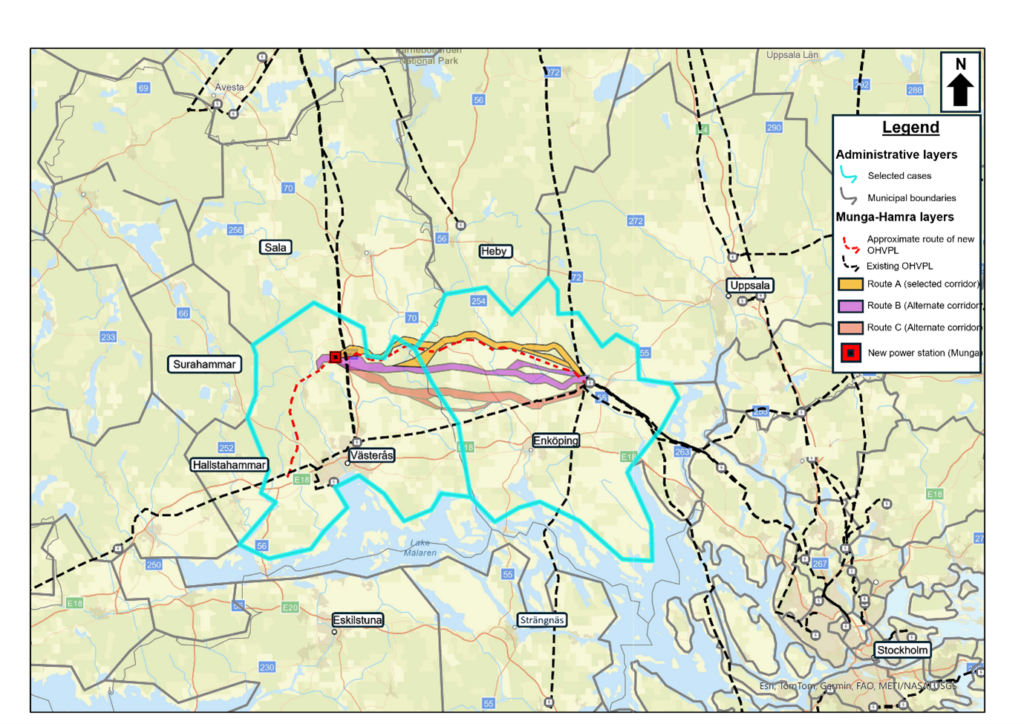
The proposed Munga-Hamra powerline route, including initial proposed routes
This critical-spatial framework is applied to the case of Munga-Hamra – a proposed OHVPL development situated across the Vasteras and Enköping municipalities – and part of a national ‘NordSyd’ (North-South) OHVPL deployment campaign in Sweden. It employs novel participatory mapping methods, in-person engagement and document analysis to understand how positionalities on Munga-Hamra were ‘anchored’ to both municipalities, the region, and Sweden as a nation.
Analyses reveal how two diverse coalitions of stakeholders have emerged to support and contest the Munga-Hamra OHVPL.
The supporting coalition is comprised of transnational energy companies, local politicians, city representatives, and state-owned national transmission company Svenska Kraftnat. They invoke arguments related to meeting national and local decarbonisation targets, reinforcing national and local energy security, and economic growth in Vasteras. They tended to ‘generalise’ and obscure the legitimacy of argument made by the opposing coalition, defining those stakeholders as ‘NIMBY’, technologically illiterate, or ill-informed.
Conversely, the opposing coalition want the OHVPL to be buried, describing significant economic impacts to agriculture and tourism across the proposed route (though primarily in Enköping), threats to local biodiversity and water reserves and cultural degradation, alongside concerns about inadequate consultation processes. They too tended to generalise the perspectives of the supporting coalition, suggesting the OHVPL was a focus for greed and corruption at the expense of working people.
We also identified several organisations, including regional and local government organisations, who adopted supposedly neutral stances in the conflict.
Overall, the analyses not only showcase the geographically-differentiated nature of conflict over OHVPL deployment, but also, how the imaginaries underpinning diverse positionalities can become more entrenched over time, in part because of how community engagement is structured (e.g., frequency of engagement). They illustrate valuable contributions that critical-spatial approaches to social acceptance – and social science research more generally – can make to ensuring democratic decision-making in instances of energy technology deployment.
Based on these findings, and my detailed understanding of the case and first-hand experiences with different stakeholders, I will make two policy recommendations:
The findings demonstrate the geographical unevenness of impacts generated through OHVPL deployment, with greater benefits to urban spaces and greater negative impact on rural spaces. Critically, the opposing coalition feel that important interrelated environmental, cultural, and socio-economic impacts were missed in the impact assessments conducted by Svenska Kraftnat – threatening the award-winning ‘Fjardhundraland’ tourism industry. This suggests that current impact assessments may be too limited in scope, failing to capture the less immediately obvious, but strongly relational, rural characteristics of places. Policymakers should consider how to ensure that more holistic place-based analyses take place in within environmental impact assessments, treating these dimensions as ‘relational’ rather than isolated.
Related to the above, at present, impact assessments for OHVPL are conducted by elite stakeholders in isolation and with limited transparency. In the case of Munga-Hamra, this facilitated strong distrust in institutional processes and in ‘elite’ stakeholders themselves – specifically Svenska Kraftnat – where strong beliefs about corruption and distrust were salient and motivated protests. Though Svenska Kraftnat followed appropriate due process, it reflects an appetite for community stakeholders to be more integrated within decision-making processes. Therefore, ensuring community participation within OHVPL (and other energy technologies) deployment processes – and capturing ‘local knowledge’ from affected community stakeholders – could help to build trust, whilst also supporting more holistic place-based assessments through providing a means to capture aspects which may be missed through more rigid impact assessment processes or technocratic perspectives.