
Cardiff University, UKERC and Understanding Risk Research Group, Schools of Psychology and of Social Sciences.
The news that Port Talbot is to develop a part of its existing port infrastructure to assemble and supply turbines for the new offshore floating wind array in the Celtic Sea is a welcome development for a town, and wider region, which might otherwise have been facing a period of continued industrial and economic decline. Port Talbot had been the site of some of the UK’s largest industrial emissions prior to the closure of the blast furnaces at the UK’s largest integrated steelworks in 2024. There are many reasons why this location has always been pivotal to the clean industrial energy revolution across South Wales. Greener steelmaking is now set to be the first component of renewal for the town, with a new electric arc furnace at Tata planned to commence operations in late 2027. And while the area might at first seem disadvantaged in the low carbon transition by its geography, including a lack of any nearby access to off-shore geological carbon storage capacity, Port Talbot and the wider region has a very long history of industrial operations (steel, engineering, chemicals, coal) firmly embedded in and supporting the local economy and communities. Therefore the announcement regarding the port and floating wind facilities is a further critical step towards the area’s promised green industrial renaissance.
The importance of current and historical industries in Port Talbot cannot be overstated. They form a core part of what defines both the place and identity of its communities. It also means that a locally based workforce already exists, together with a longstanding tradition of skilled employment in the steelworks and its allied engineering industries. Connected by excellent transport links, a growing knowledge economy in the South Wales Universities, and the existing grid connections, Port Talbot would seem the ideal place for the green energy renaissance to take root within the South Wales industrial cluster. The town might also prove to be a model for what a genuinely just transition might look like in a formerly heavily industrialised region. In this regard, one can criticise the last UK Government for not moving fast enough to support the electric arc development, and the current one for not fully appreciating the short-term regional and national strategic value of keeping the Tata blast furnaces going until the electric arc is fully operational. Doing either would have avoided temporal disruption, guaranteeing a smoother and less fragmented transition to greener steel making while bringing greater continuity of training opportunities and employment too. Timing, it seems, is critical for planning any just industrial transition.
Extending social science public engagement research methodologies pioneered by UKERC , our recent place-based research with community members in Port Talbot has included their consideration of how different localised scenarios for a clean energy transition might impact the region and town[NP1] and also the Port Talbot Dock Vision of re-industrialisation that included the possibilities of floating wind fabrication and new port infrastructure. This research has illustrated the extent to which these new developments will need to play into existing narratives of identity, industry and everyday life in the town.
Three conclusions follow from our research.
Building and Maintaining a Social License
One conclusion from our work in Port Talbot is that new industrial developments will need to work alongside the local communities and their representatives to develop a social contract for change. Our UKERC research on public acceptance of energy system change has shown clearly that the foundations for such a social contract already exist in principle, but only if the right conditions for a genuinely transformative, joined-up and sustainable energy transition are met. Often tacitly agreed, and noticed only when broken, at a local or regional level such social contracts are often characterised in terms of a ‘social license to operate’ – a term originating from the extraction industries. Here, a local agreement is sought as part of an organisation’s commitment to social responsibility such that that activities which might otherwise be viewed as risky or polluting can go ahead with at least some degree of community consent. This can involve operators providing economic or other tangible benefits, but critically also showing responsiveness to community concerns. In an ideal world, ongoing community engagements would provide a framework for identifying ‘conditions on acceptance’ that help to shape the precise nature and extent of industrial operations and their impacts locally.
Super Place or Super Town?
A second key insight arising from our public engagement research in Port Talbot is that local concerns run far wider than simply that of a social licence for industrial infrastructure and activity. In a day-long community workshop we presented to people the Associated British Ports vision that emphasised the port development and floating wind proposals in terms of a ‘Super-Place’. However, a number of our participants took this concept and repurposed it into their own idea of a ‘Super-Town’. It is a well understood feature of public engagement that participants will ‘open-up’ discussions, through reframing issues and technology proposals in productive ways that reflect what really matters to them.
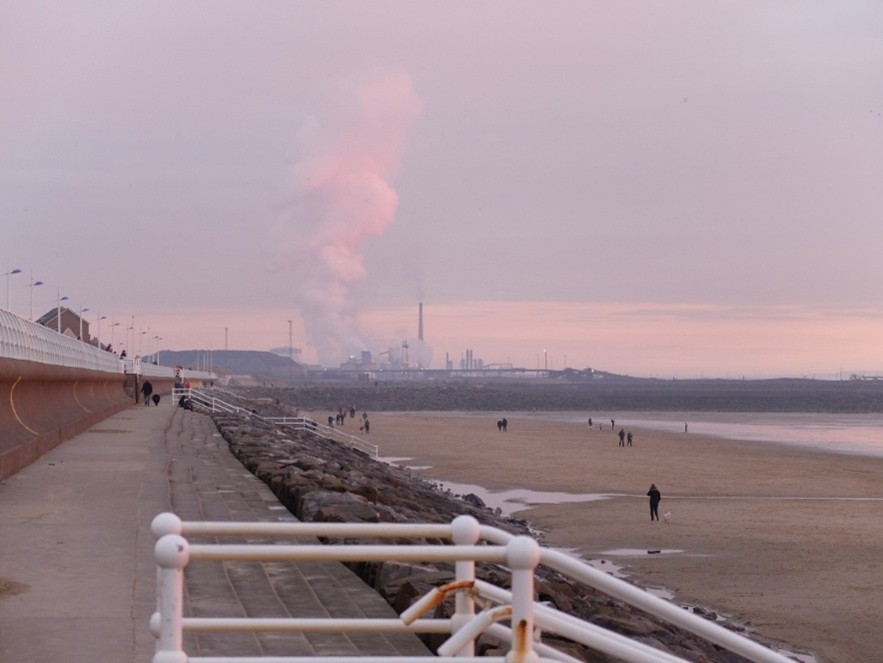
The town centre and amenities of Port Talbot themselves have been blighted socially by a long history of economic decline, and further by its poor air quality stemming from both the steelworks and the adjacent motorway. Narratives portraying how townsfolk experience the decline as a local stigma, however, were readily transformed into public sentiments (humour, distrust) about local authorities and businesses who are perceived to be indifferent or profiting from this. The strong desire by our participants was for the clean industrial revolution to be constructed as part for a much wider vision for a Super-Town – in such a way as to regenerate the town centre and its facilities while also not detracting from already highly valued aspects including its green spaces, historic Margam Park, and an extensive beach at Aberavon with one of the very best sunsets to be seen along the South Wales coast.
Infrastructural Ecologies and Relational Risk
Thinking about a social licence as encompassing a Super-Town led us to adopt a relational understanding of processes of change and transition risk, framed by us as ‘infrastructural ecologies of place’. By a relational approach to risk, we mean that our psycho-social understandings, practices and perceptions of what constitutes risk are shaped by and embedded in the emotional and social relationships that we hold with other people, organisations, forms of governance and identities of place. Particularly significant here are the ‘public objects’ which might either enhance or alternatively detract from wellbeing. Adopting such a perspective on change in an industrial setting in turn brings to light the importance of what can be termed infrastructural ecologies(the ways in which past and present material and psychological objects across both local and global scales, and their good and bad interrelations and emotional affects, inform current responses to change).
The research illustrated this complexity of relations only too clearly, illustrating also how Port Talbot presents a contained and ultimately resilient infrastructural ecology for many participants. Such containment produces community resilience through the capacity to integrate hopes and fears for the future within existing understandings of localities. Adopting an approach to transition risks in terms of infrastructural ecologies also helps to move us beyond simple ideas of public acceptance, public understanding of technology change, or even that of social license, to encompass genuine responsiveness to the systemic concerns that public engagement with clean energy in all its diverse forms raises. The key lesson here is that providing net zero infrastructure should not be seen as an end in and of itself but must always form a part of wider conversations about and with communities facing transition.
In South Wales the hope will be that these new developments for Port Talbot are only the start of a major green industrial transition across the region as a whole, and in ways that are proportionate, genuinely fair, and above all sympathetic to local concerns and aspirations. Time only will tell, but the green shoots may already be there.
Reference Links to Insert into Text
Butler, Parkhill and Pidgeon (2013) Transforming the UK Energy System: Public Values, Attitudes and Acceptability – Deliberating Energy System Transitions in the UK | UKERC | The UK Energy Research Centre
Henwood, K.L and Pidgeon, N.F (2025) Lively methods for net zero governance and public engagement. British Academy Net Zero Governance Paper Series. www.thebritishacademy.ac.uk/documents/5825/Lively_methods_for_net-zero_governance_and_public_engagement_-_2025.pdf
Parkhill, K. et al (2013) Transforming the UK Energy System – Public Values, Attitudes and Acceptability | UKERC | The UK Energy Research Centre.
Pidgeon, N.F. (2020) Engaging publics about environmental and technology risks: frames, values and deliberation. Journal of Risk Research doi.org/10.1080/13669877.2020.1749118
Roberts, E., Groves, C., Thomas, G., Shirani, F., Cherry, C., Henwood, K.L. and Pidgeon N.F. (2023) Attuning to ambiguous atmospheres: Currents of air, discourse and time in a steel town. Transactions of the Institute of British Geographers, DOI: 10.1111/tran.12631
Smith, H., Pidgeon, N.F and Henwood, K.L. (2025) The infrastructural ecologies of industrial decarbonisation: visual methods and psychosocial logics in place-based public engagement. Energy Research and Social Science, 119, https://doi.org/10.1016/j.erss.2024.103874
Stephanides, P., Chilvers, J., Honeybun-Arnold, E., Hargreaves, T., Pallett, H., Groves, C., Pidgeon. N.F., Henwood, K.L. and Gross, R. (2025) Beyond public acceptance: Towards systemic societal responsiveness of net zero infrastructures. Energy Research and Social Science, 127. 104251, https://doi.org/10.1016/j.erss.2025.104251
Thomas, G., Cherry, C., Groves, C., Henwood, K.L., Pidgeon N.F. and Roberts, E. (2022) “It’s not a very certain future”: Emotion and infrastructure change in an industrial town. Geoforum, 132, 81-91.