Journal article
From Coal Town to Smart Town: Place, Power, and the Politics of Energy Decentralisation
22 July 2026

Across the world, governments are exploring the potential of decentralised energy systems — the ‘local’ deployment of technologies such as rooftop solar, batteries, heat pumps, and smart grids — that can enable communities to generate and manage their own energy generation and consumption. Initially, there is a clear rationale for such systems: localising energy can ensure fairer, greener, more democratic outcomes, addressing both decarbonisation and social justice issues, whilst addressing the place-specific opportunities and challenges of a community.
However, a study published in Energy Research & Social Science asks an uncomfortable question — what happens when the initial decision making in these ‘local’ projects (for example, decisions about the project boundaries and inclusion criteria) takes place without community input? In this instance, such projects emerge by being designed for a community rather than with one. What impact does this have on how communities respond to the project and their beliefs about the effectiveness of such projects to achieve decarbonisation and social justice outcomes?
The paper, by Adam Peacock (University of Edinburgh) and Zoe Robinson (Keele University), examines a real-world case: Zero Carbon Rugeley (ZCR), a smart local energy project planned for Rugeley, a former coal-mining and power-station town in Staffordshire, England. Unlike grassroots, community-owned energy schemes, ZCR was what the researchers call a “Top-Down Decentralised Socio-Technical Imaginary” (TDDSTI) — a decentralisation project conceived and steered by an external coalition of companies, non-governmental organisations and Keele University, led by the transnational firm Equans, which had bought Rugeley’s old coal-fired power station site with ambitions for redevelopment.
The authors were uniquely placed to study this – involved as both researchers and the practitioners hired to run ZCR’s community engagement. That dual “insider-outsider” role offered two advantages: first, it let them observe, from the inside, how project developers tried to ensure ZCR felt authentically like Rugeley (e.g., tapped into its place-specific characteristics); second, it enabled them to evaluate how residents responded to those processes.
Developing an existing theoretical framework by Walker et al (2021), the researchers identify three strategies developers used to legitimise ZCR as a natural fit for the town — what the academic literature calls emplacement, place-framing, and place-making.
Emplacement meant place branding: naming the project “Zero Carbon Rugeley,” and describing the town in press materials as a place where, “for many years,” energy “has been part of its story.” This framed the new smart-grid scheme as simply the next chapter in a long energy heritage stretching back to the coal mines and power station.
Place-framing meant setting the project’s goals — presenting Rugeley not just as a beneficiary of decarbonisation but as a flagship that could catalyse similar projects elsewhere, tying a very local town to distinctly non-local, global climate ambitions.
Place-making meant defining who, what and where are included or excluded: developers arrived with a pre-set boundary of “the Rugeley community” and its surrounding villages, defining who would be affected and consulted — a boundary drawn before any community had a say in it.
Collectively, the researchers identify how these strategies produced a ‘fixed’, pre-packaged version of Rugeley’s identity, into which the technical details of the project (which were still largely undecided) could later be inserted.
The paper then aims to understand how residents felt about the project and the place brand they were presented with. To do so, the researchers ran creative cultural animation workshops — asking people to bring objects from home that represented Rugeley to them — alongside social media engagement and interviews with local community leaders.
Two distinct, sometimes overlapping place imaginaries emerged. One group held onto a ‘Natural Rugeley’ identity — rooted in the town’s greenbelt, woodland, and wildlife. These residents, often already involved in sustainability projects, tended to feel positively about ZCR; it offered hope and validated the future they already wanted.
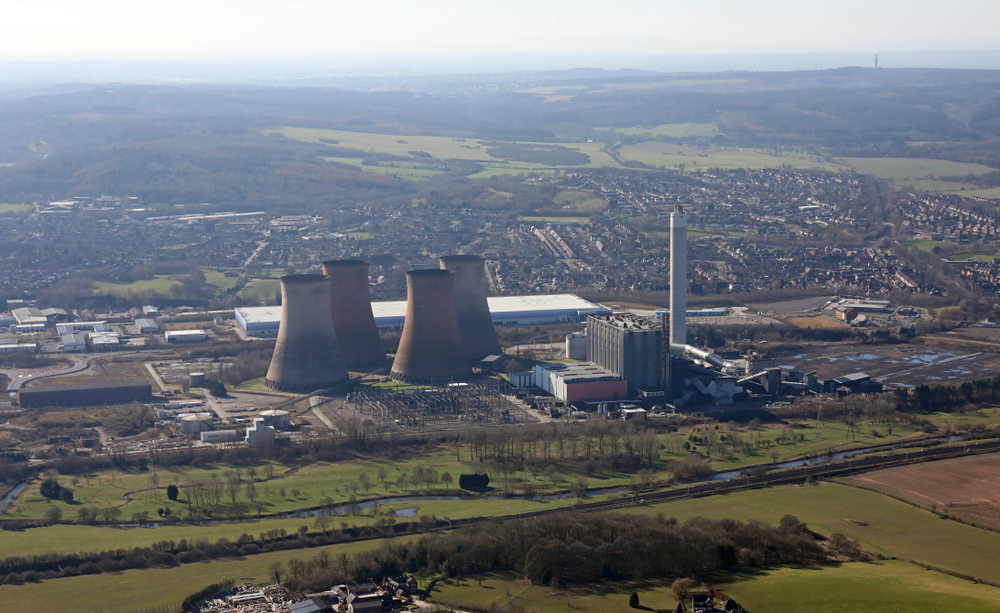
A larger group held onto an ‘Energy Heritage Rugeley’ identity — centred on the coal mines and the power station’s cooling towers, which for decades physically dominated the skyline. But this identity was far from uniform. For some, the towers were “home,” a source of pride and childhood memory. For others — particularly those in former mining estates — they were reminders of unemployment, pollution, and decline following the mine and power station closures.
Overall, the paper demonstrates the need to account for the intra-local complexities of people and places. The developers’ isolated attempts at place branding only aligned with the positive version of the energy heritage narrative — reimagining the coal legacy into a clean future — while ignoring the deprivation and loss many residents actually associated with it. Community gatekeepers described Rugeley as having “two bits”: more affluent newer estates, an “easy sell” for the project; and former mining estates, a “very closed community” and a much “tougher sell”. Some social media respondents also pushed back on the idea that a small town like Rugeley should be positioned as a global decarbonisation flagship, arguing it was unfair to expect ordinary residents to take on the responsibility for emissions produced largely by other nation states or wealthier, more polluting actors elsewhere.
For policymakers designing the next generation of place-based decarbonisation schemes, there is one overarching lesson: genuine community involvement can’t be retrofitted onto a project after its identity and boundaries have already been decided. If local energy transitions are to deliver on their promise of fairness and inclusion, communities must be included from the very beginning — as they can resist ‘local’ visions they did not co-design.