
On 17 February we hosted the first ‘EERA Day in the UK’, the event co-hosted with the European Energy Research Alliance (EERA) and UKRI, focused on strengthening ties between the UK energy research community and EERA. It was the latest in a series of national events being organised by EERA, with others having taken place in Norway, Spain and France.
The day kicked off with a joint welcome by UKERC Director Rob Gross and EERA President Henk-Jan Vink. This was followed by a session that provided a grounding for the day’s proceedings, including an overview of EERA, and the energy research context in both the UK and the EU.
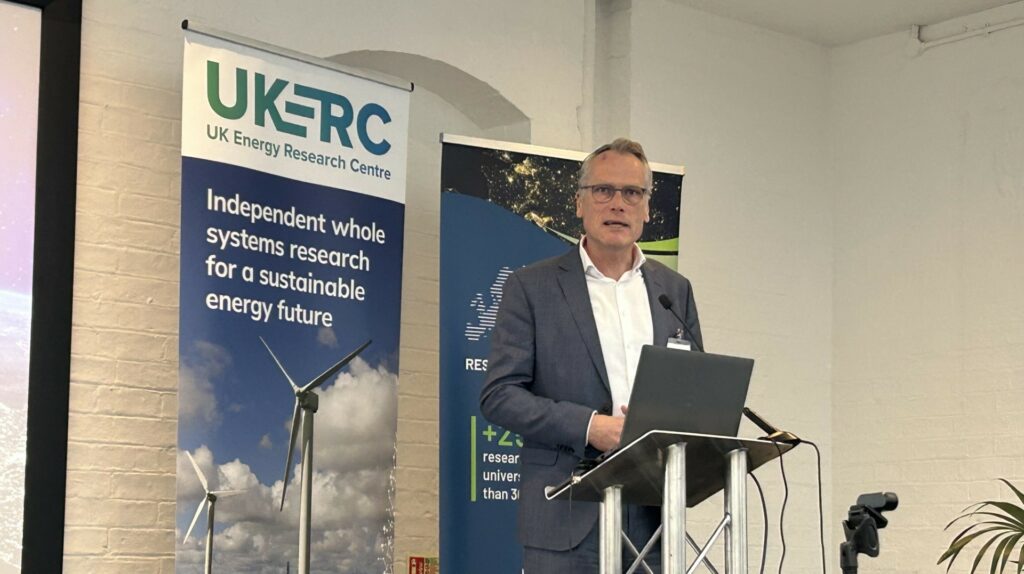
EERA President Henk-Jan Vink addressing the conference
Prof. Adel El Gammal, EERA Secretary General, highlighted the breadth of subjects covered by the 18 joint programmes and the key role they play in informing the European Strategic Energy Technology Plan (SET Plan). Adopted by the European Union in 2008, the SET Plan aims to support the EU in reaching its climate neutrality goals, and boost Europe’s position as a leader in the areas of clean energy and energy efficiency.
Beatrice Coda from the European Commission joined online and spoke about the increasing importance of strategic independence when it comes to energy security. She highlighted the Draghi report which called for greater alignment of priorities, and defragmentation of funding across the EU. In this context, the SET Plan provides a framework to achieve this target, with plans for flagship actions to build new collaborations across the ecosystem of communities, encompassing industry, academia and government, to address the scale of the climate challenge.
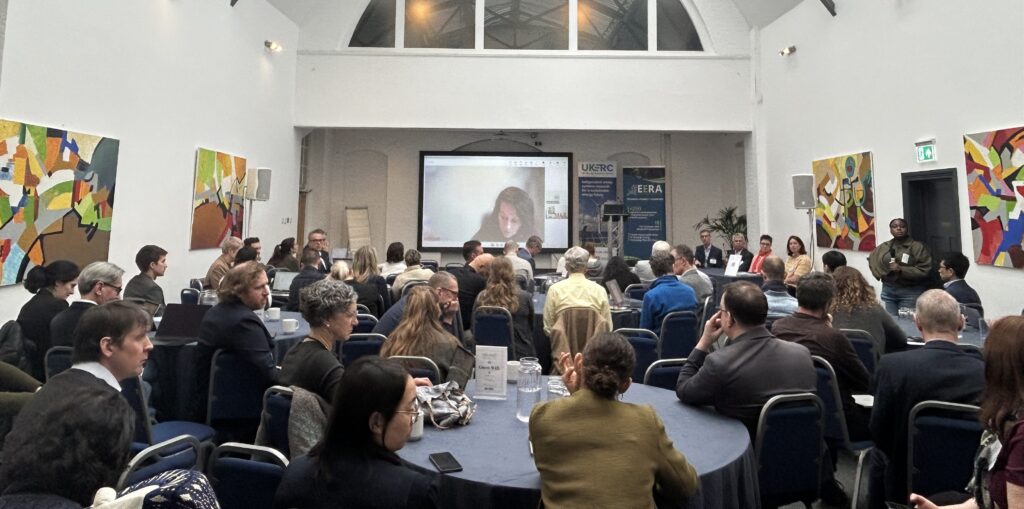
Beatrice Coda addressing the conference
Prof. Charlotte Dean, EPSRC Executive Chair, highlighted the alignment between UK and EU energy and climate goals, and how UKRI priority programmes such as ‘Clean Growth and Energy’ feed into these. Within this context collaboration between universities and businesses across national boundaries is vital – with more than 40% of EPSRC funded projects including international partners.
Dr. Anna Stephenson, Deputy Director of Science and Innovation for Climate and Energy, provided an overview of UK energy priorities and the role that R&D plays in developing evidence-based policies, such as those that feed into the Clean Energy Superpower Mission. She highlighted the benefits identified that following a high-innovation net zero pathway can bring, and the role of R&D in delivering economic growth and energy security.
Session 2 focused on UK-EU research collaboration in practise, through the lens of four different projects.
Prof. Henry Jeffrey, University of Edinburgh, described the three main types of European projects to get involved with: ‘Research and innovation’ projects which are led by universities with some industry input, and typically focus on low technology readiness levels (TRLs); ‘Innovation’ projects which are industry led with some academic input, and typically focus on higher TRLs; and finally ‘Coordination and support’ projects where institutions act as enablers, co-ordinating projects.
Dr. Ami Crowther, Anglia Ruskin University, then focused on social science and humanities projects, drawing on the Shared Green Deal project, which looked at home retrofits across Lithuania, Hungary, Spain and Ireland. She highlighted some of the benefits of working on UK-EU projects, including the opportunity to engage in unique policy focused discussions, access to some of the best expertise, and the opportunity to obtain funding for projects.
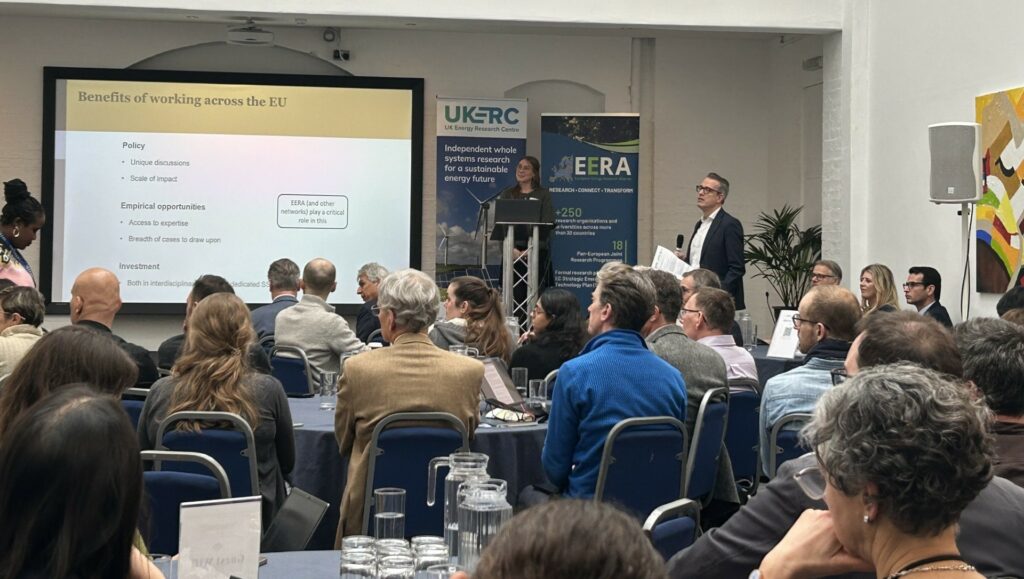
Dr. Ami Crowther presenting with Dr. Ivan Matejak chairing
Dr. Cristina Garcia-Duffy, Offshore Renewable Energy Catapult, illustrated the variety of projects she has participated in via the EERA Joint Programme on Wind, with topics ranging from how to integrate wind into the system, to projects on skills and acceptability. She also highlighted the key role of organisations such as EERA in reducing duplication across the sector and enabling European competitiveness.
Finally, Prof. Meysam Qadrdan, Cardiff University, brought an energy systems perspective to the session, drawing on the H2020, Virtual Power Plant for interoperable and smart isLANDS project, which encompassed 20 partners across 7 countries, and focused on the stability and decarbonisation of grid islands.
Session 3 focused on priorities for the future and included two presentations followed by group discussions.
Hilary Aveyard, Horizon Europe Policy Lead, Department for Science, Innovation and Technology, explained her role in ensuring researchers can participate in Horizon programmes and access funding. She stressed the importance of openness in enabling experts from across Europe to collaborate scientifically, and welcomed the European Commission proposals for FP10 (the Framework Programme for Research and Innovation for the period 2028-2034) to drive economic growth. Hilary also highlighted that it is not just about looking forward to the future Horizon programme, noting that one third of the current funding round is yet to be allocated.
Rosita Zilli, EERA Policy Director, then presented, drawing from a recent EERA FP10 position paper. The European Commission proposal for the 2028-34 budget is €1.8 trillion, of which 35% will support climate action and environmental objectives. Set within this is the European Competitiveness Fund which includes Horizon Europe, with FP10 having been allocated a total budget of €175 billion. Rosita outlined the timeline for, and key players in, negotiations around the allocation of the FP10 budget. She also discussed some of the more challenging points in these negotiations such as FP10 autonomy vs integration within the European Competitiveness Fund, the role of partnerships vs open calls, and flexibility vs predictability. In this sense she perfectly set the scene for the ensuing group discussions which focused on questions such as what technologies and themes should be prioritized, and how research should be commissioned and delivered.
After an informative and engaging day, the event was closed by EERA President Henk-Jan Vink, and Prof. Jim Watson, the UK EERA Executive Member.
Jim highlighted that whilst there is lots of change, there is huge scope to align and collaborate on the challenges that this presents. With better knowledge individuals are better equipped to respond, and there is a need for agility, with the prevailing context now being a focus now on competitiveness and resilience.
A special thanks is required to the organising committee members:
If you would like more information about the event or engagement with EERA please contact Jessica Bays.