
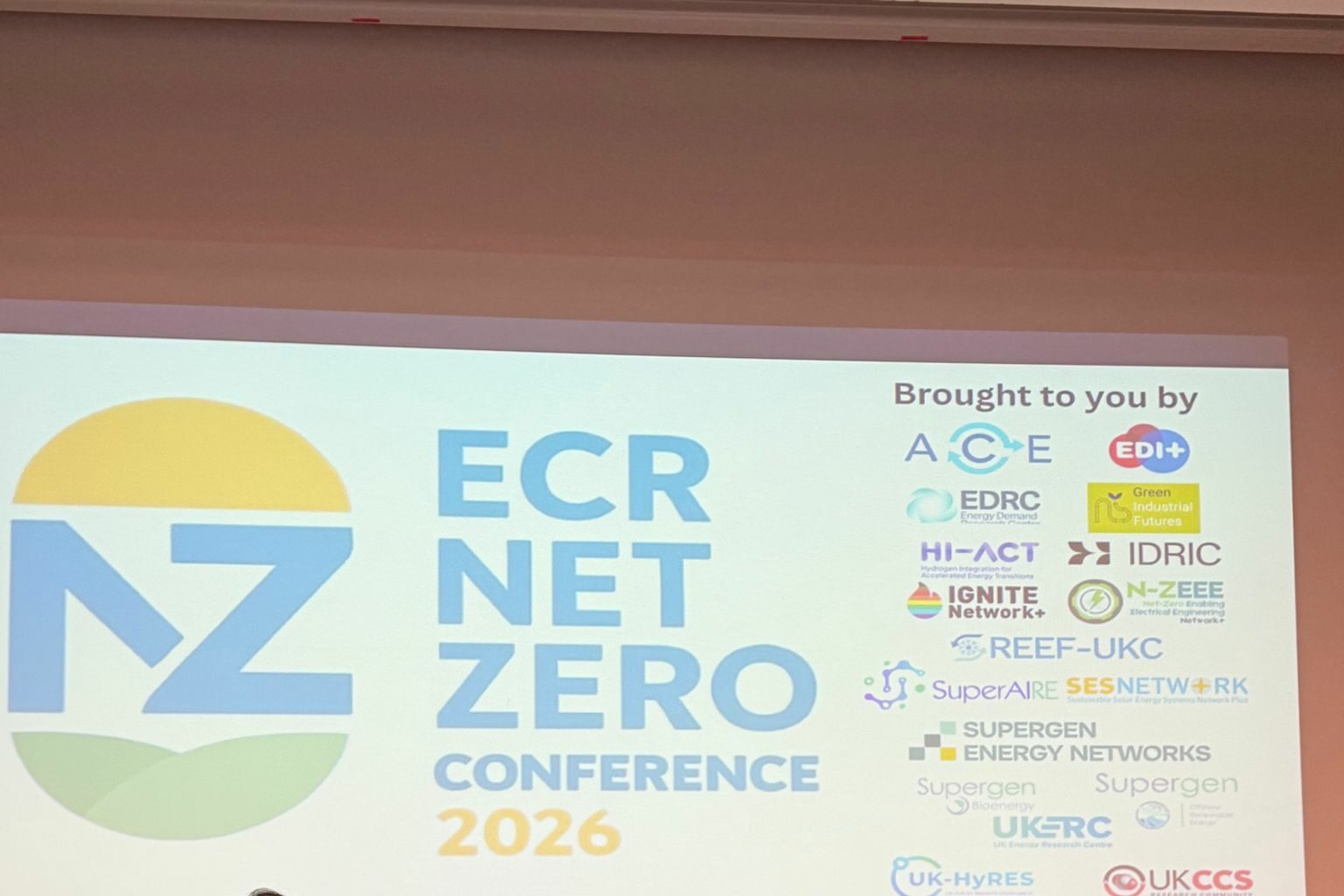
It was exciting to attend and co‑chair the 3‑minute pitch and poster sessions at the ECR Net Zero Conference in Birmingham, on behalf of UKERC and the Centre of Energy Policy. Held on 9–10 March 2026 at the Birmingham Conference and Events Centre (BCEC), the conference brought together early career researchers from across the UK, all working toward one shared goal: advancing the journey to net zero. Alongside the insightful research presentations, what really stood out to me was the people, the conversations, the connections, and the shared energy in the room.
The opening keynote by Professor Sarah Walker, Director of HI-ACT, Co-Director of the Birmingham Energy Institute at the University of Birmingham, and UKERC Advisory Board member immediately set the tone. It didn’t feel like a typical academic talk. Instead, it was personal, reflective, and deeply human. She spoke about a non-linear career shaped by both professional and life experiences. That message resonated with me a lot. It also made me reflect on my own journey across the energy sector – from power generation to policy advocacy, consultancy, international development, and academia. Each experience continues to shape how I think about net zero and the wider energy transition, not just as a technical issue, but as something that affects people, communities, and everyday lives. For me, the key reminder was that careers do not always need to follow a straight path. Sometimes, the detours and unexpected opportunities are where we learn the most, grow the most, and find new ways to make an impact.
One of the sessions that stayed with me was the panel on global energy policy and the just transition, chaired by Joshua Lait. The panel featured Ami Crowther (Anglia Ruskin University), Josh Deru (UK Climate Change Committee), Donal Brown (University of Sussex), and Charlotte Ray (University of Bristol). The discussion was rich, balanced, and honest about the challenges we faced.
Two questions from that session really stuck with me. First: should energy policy focus more on improving human living standards while also protecting natural systems? And second: how do we realistically balance living standards, environmental protection, and both supply-side and demand-side solutions within a just transition framework? These aren’t easy questions, but they truly matter. What I appreciated was how the conversation brought together perspectives from academia, policy, and industry—it made the discussion feel grounded more in reality.
I also had the opportunity to deliver a 3-minute pitch on UKERC, where I introduced the 2024-2029 Phase of the Consortium programme and highlighted its key themes – from energy infrastructure and renewable systems to energy justice, geopolitics, and responsive research. I also shared insights from my current work on a rapid evidence review of Great British Energy, the UK’s newly established publicly owned energy company. The aim of this research is to draw lessons from other successful publicly owned energy entities to help inform its strategic direction.
Another highlight for me was co-leading the poster session alongside Dr Emma Edwards (Offshore Renewable Energy Hub, University of Oxford) and Gayatri Sundar Rajan (Department of Engineering Science, University of Oxford). It was a dynamic and rewarding experience – coordinating submissions, engaging with presenters, and helping to select and recognise outstanding work. More than anything, it gave me a deeper appreciation for the breadth and creativity of research happening across the ECR community.
One session that really made me pause and reflect was on Equality, Diversity and Inclusion (EDI), led by IGNITE Network+ and EDI+. It challenged us to think about what happens when research, no matter how strong, overlooks certain groups or lived experiences. For me, the key takeaway was simple: the more inclusive our research is, the more relevant and impactful it becomes.
I also found the session on presenting research with confidence, led by Duncan Yellowlees, incredibly practical. It focused on what actually works for the individual, rather than offering generic advice. One thing that stayed with me was the idea that communication is not about sounding perfect, it’s about making sure your audience understands you. That shift in perspective felt important, especially for those of us working on complex topics that need to be accessible beyond expert’s circles.
The conference also explored career pathways, funding opportunities, collaboration, and research impact, alongside a range of parallel sessions led by ECRs across different themes. Each session added another layer to the experience, reinforcing how interconnected and interdisciplinary the net zero challenge really is.
Looking back, what I take away most is this: the journey to net zero is not just about data, models, or technical solutions. It’s about people. It’s about collaboration, communication, and shared purpose. Being surrounded by such a diverse and passionate group of early career researchers reminded me that while the challenge is complex, we are not tackling it alone—and that, in itself, is incredibly powerful and hopeful.