
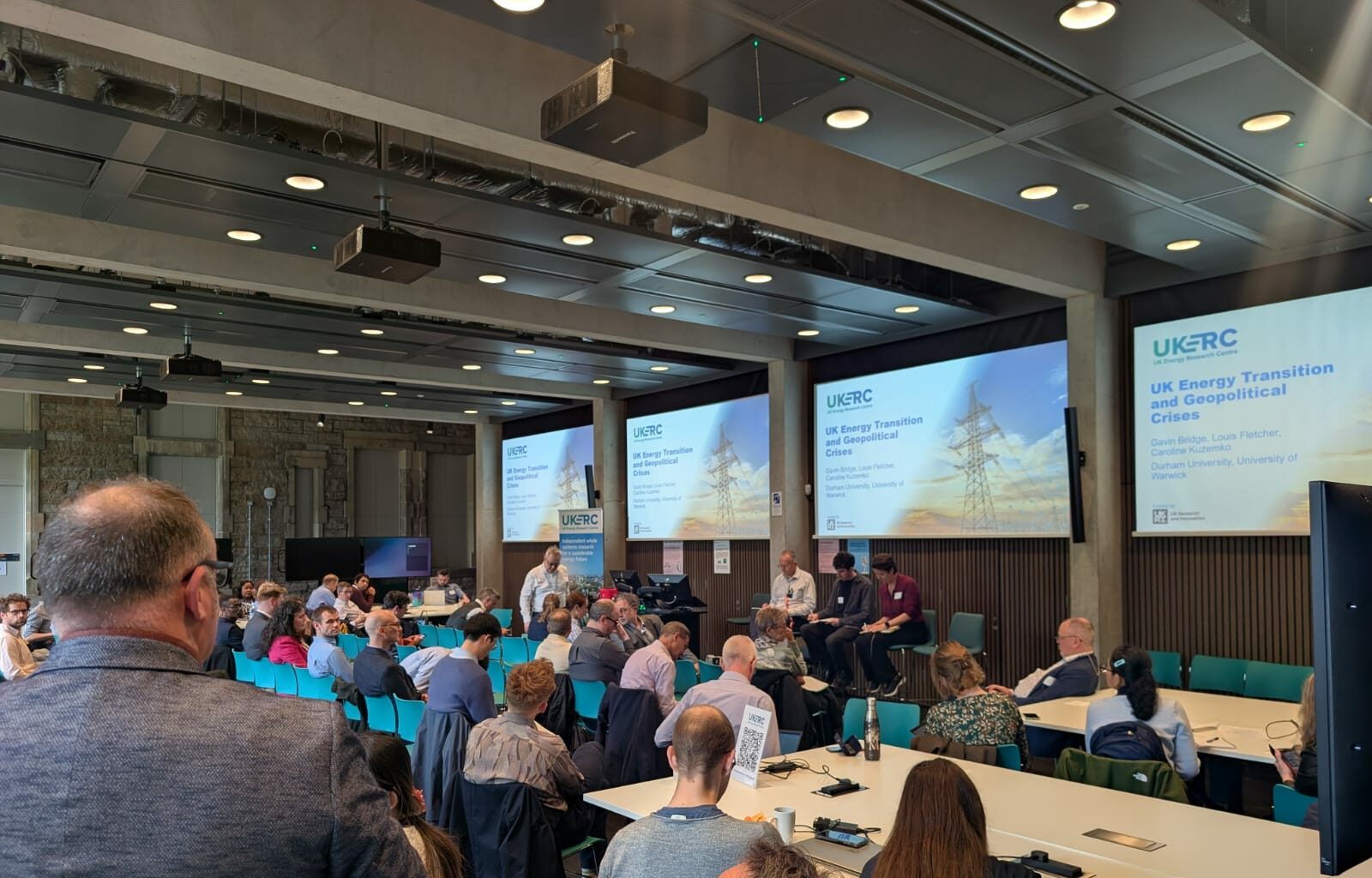
The UK Energy Research Centre (UKERC) Annual Assembly, held on 20th and 21st May 2026 at the Edinburgh Futures Institute, brought together researchers, partners and stakeholders from across the consortium for two days of shared learning, discussion and reflection. For those of us earlier in our research careers, this was a valuable opportunity to see how our work fits into the wider picture and to learn about all the interdisciplinary research and what we can do to contribute more meaningfully.
For the early career researchers (ECRs), this Assembly opened with a workshop, facilitated by an experienced facilitator and coach, Sandrine Soubes, focused on establishing a research niche. Through a series of discussions and thought-provoking questions, we explored how our research niche is not just our specialism, but also our experiences, values and wider interests. Sandrine encouraged us to think about our own personal paths rather than to compare our progress to our peers. We are all individuals, and it is this uniqueness that allows us to bring different perspectives and approaches to our research group as we work towards a more energy efficient world.
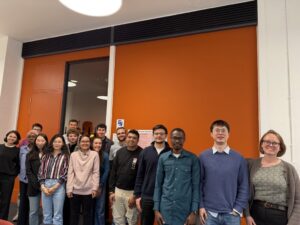
Within UKERC’s ECR network, we are all at different stages, both professionally and personally, and our trajectories are all different. The goal is not to reach the same destinations at the same pace with the same experience, but rather to develop a research direction that is genuinely our own and genuinely useful to others. It is our mix of experiences, subject knowledge and interests that allows UKERC to span a range of energy-related research, from community to policy and everything in between.
The inherently interdisciplinary nature of UKERC was clear throughout the Assembly, right through the Centre’s research updates and panel discussions. This reminded us of the value of being part of a research community that has long sat at the centre of the UK energy debate, with a unique ability to connect whole system thinking, technical evidence and real-world priorities. Across the sessions, academic, policy, industry, government and civil society were brought together, not only in their depth of expertise, but in a clear willingness to reflect on how our research can better respond to lived experience and the pressures facing decision-makers and society. Impact was not treated as an endpoint, but as something that shapes the questions we ask, the partnerships we build and how our research develops.
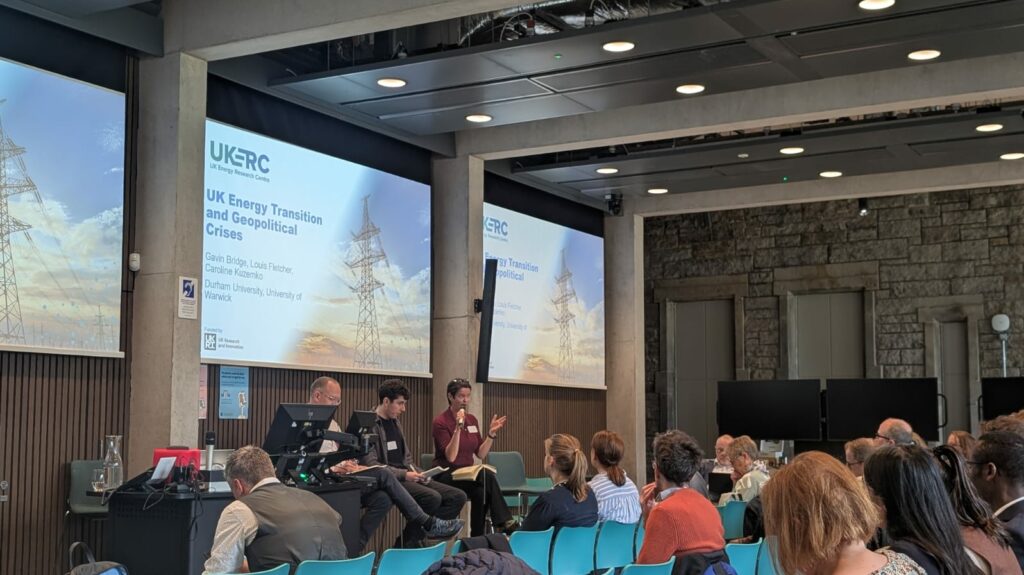
This year’s Annual Assembly was held against the backdrop of major global energy disruption caused by the war in Iran and the closure of the Strait of Hormuz. The energy crisis that these geopolitical events caused is once again affecting UK consumers with an increase in fossil fuel prices and energy bills. Inevitably, energy geopolitics was part of the discussion in how ongoing research can address the questions of energy security and resilience in the UK, and what lessons we can learn from previous crises and how to prepare for the next.
Energy crises highlight the interconnectedness of the global economy, through which we can reflect on our domestic resources and solutions. Geopolitical conflicts come and go, but we still need to wean ourselves away from a fossil reliance to become more resilient to current and future global energy crises, as well as mitigating the impacts of climate change. As such, there is a need for evidence on how the UK can better protect and make its energy sector more resilient, especially as we move toward electrified heat and transport sectors powered by renewable energy and supported by long duration energy storage. There were reflections on what lessons can be learnt from previous crises, and how best to prepare for the next one.
Public discourse is becoming more polarised, with competing views on how the energy sector should be shaped in response to geopolitical events in an era of instant information and rising disinformation circulating online. UKERC researchers have been working to get accurate information out in the public domain when world events and the media require expert input, particularly around clean energy transition and energy security. This has been particularly evident during the current energy crisis, with UKERC colleagues appearing in media coverage to provide expert insights. This underlines the importance of clear messaging and strong narratives when communicating research outputs, as well as the need to draw on and cultivate the wealth of knowledge and experience within the Centre to respond promptly and effectively.
The notion of communication was strong throughout the Assembly, particularly in terms of climate change, the energy transition and net zero. There was discussion regarding how our narratives need to continue to highlight the challenges faced, measures implemented and the need for our work while also being relevant to all people. Understanding what motivates people to make changes, or be resistant to change, is key during the energy transition. It is important that there is knowledge exchange between communities, industry and academia at all levels.
Working toward net zero is not a purely technical challenge, it is also a highly social and political one, and increasingly a contested one. We are living through a period of growing polarisation, and the instinct to simply present better evidence and hope it lands is not sufficient. What stood out at the Assembly was UKERC’s ability to create space for engaging with complexity, rather than simplifying it away. Discussions around ‘constructive contestation’ showed how engaging with disagreement can strengthen the relevance of research. For those of us working at the research-policy interface, this is a useful reminder that impact often sits within these contested spaces, not outside them. This means creating space for the concerns of people who are sceptical, resistant, or simply unconvinced, and recognising that net zero is not a one-size-fits-all proposition. Listening to concerns, opinions and priorities allows us to develop relevant research and messaging that is clear, accessible and useful.
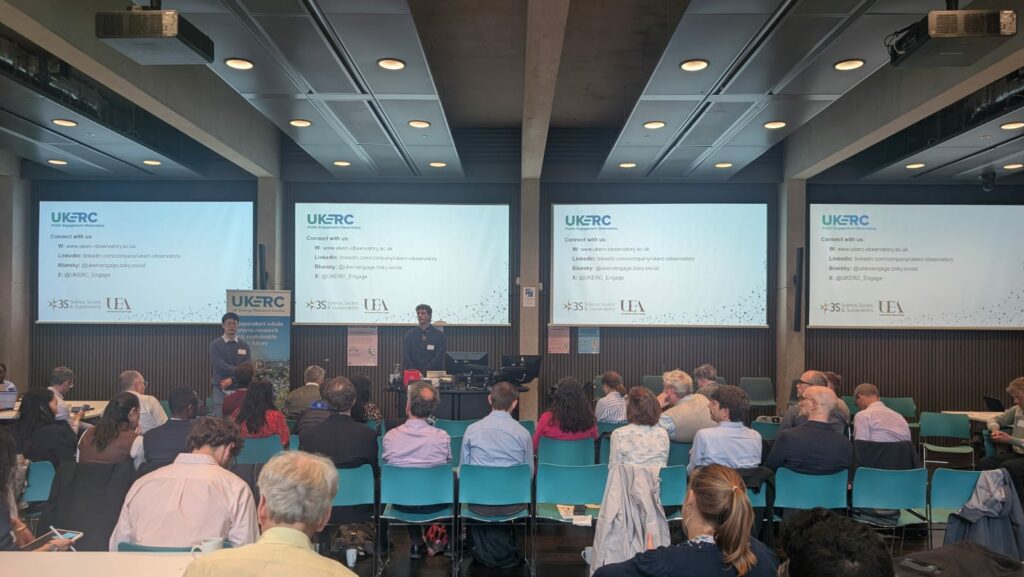
Public engagement emerged as a core strength and value of UKERC. The Public Engagement Observatory recognises that people are already actively engaged with energy issues, including, for some, through dissent and contestation. UKERC’s longevity is an important asset here, offering a way to learn from past cycles and improve the framing and sharing of evidence in timely and useful ways. Capturing public opinion on energy issues is a positive step in bridging the gap between academics and society, and it is paramount for researchers to engage with this work and to understand better how the research can be translated for diverse audiences and inform public debate.
The Assembly highlighted UKERC’s value in supporting researchers in navigating a shifting policy and funding landscape. Its emphasis on collaboration, interdisciplinarity and exchange enables work that is both robust and grounded in technical, social and economic realities. Contributions from energy stakeholders further anchored discussions in practice. By placing co-designed impact questions at the centre of research, and continuing to work with policymakers, funders, businesses and civil society groups, we can continue to strengthen our impact and better align with policy cycles through concise syntheses and timely briefings.
With the Centre spanning many groups and universities, the Assembly offered a chance to regroup and share experiences and thoughts. Within UKERC, ECRs are encouraged to be active members and there was active and intentional consideration given to include us and our ideas. The ECR presence was visible in the planning, within panel discussions, the dedicated workshop and reflections, such as this article.
As ECRs, many of us attending for the first time, it was valuable to see how our own research fits into the wider themes of UKERC, where there are links for future collaboration and areas on which there could be expansion. Both the initial workshop and main event offered valuable spaces to connect with colleagues, reflect on our career development and share perspectives on the opportunities and challenges ahead. As part of the UKERC consortium, ECRs can develop their research careers with a sense of stability and shared learning through its long-term collaborative projects. UKERC provides an excellent space for ECRs to build networks and support one another as we navigate our research and professional journeys, forming relationships with colleagues with whom we will progress through research and industry alongside. The active inclusion of ECRs at various levels allows us to gain invaluable insights from colleagues and collaboration opportunities with more senior and experienced researchers.
There are many projects on the go, and it was striking to see how passionate and engaged all the researchers are about their own work and that of others. There was a very welcoming atmosphere throughout, with many ECRs meeting each other for the first time, as well as connecting with people working in different themes. This demonstrated the value of such events in bringing our research community together as we continue to work in responsive, cross-sector and impactful research.
Our final thoughts are that impactful research is as much about relationships and engagement as it is about evidence. UKERC provides both the platform and the community to do this well, supporting us to stay engaged in the challenging, often messy spaces where research, policy and public concerns meet, and where meaningful insight and impact are shaped.